A chemical reaction is represented by a chemical equation that involves ions, atoms and molecular formulas. Use this resource to will learn about the main components of a chemical equation, and how to write and balance chemical equations. Also read about how Aboriginal peoples apply their understanding of chemical reactions.
The main components of a chemical equation are:
Reactants – the starting materials of the reaction. Reactants are written on the left side of the equation.
Products – the materials obtained at the end of the reaction. Products are written on the right side of the equation.
An arrow – drawn between the reactants and products pointing towards the products to indicate a chemical change
Conditions required for the reaction to occur—such as pressure and temperature—written above the arrow
Physical state of the substances involved – written next to the chemical formulas using brackets and abbreviations
solid – (s)
liquid – (l)
gas – (g)
aqueous solution (a substance dissolved in water) – (aq)
Coefficients – the numbers written before the chemical formulas to balance the chemical equation.
According to the law of conservation of mass, matter cannot be created nor destroyed. None of the atoms disappear during a chemical reaction. Instead, atoms rearrange to form new chemical compounds. Therefore, the total number of atoms of each type on the reactant side of the arrow must be equal to that on the product side.
Example 1 – writing balanced equations for chemical reactions
Write the balanced chemical equation for the reaction between nitrogen gas and hydrogen gas to produce ammonia gas.
Step 1: Write the reactants and products of the chemical equation using correct symbols and formulas. The reactants are written on the left side of the arrow and the products are written on the right. Use a plus (+) sign to separate each reactant or product from others.
Step 2: Balance the chemical equation by writing the correct coefficients in front of each chemical formula. In a balanced chemical equation, an equal number of atoms of each element involved must be present on either side of the arrow. Choose one atom to balance at a time. Let's start with the compound that is composed of the greatest number of atoms.
The compound with the greatest number of atoms is ammonia. The element in ammonia with the highest number of atoms is \(\ce{H}\). The reactant side contains \(3\textrm{ H}\) atoms. On the product side, \(\ce{H}\) contains \(2\textrm{ H}\) atoms.
To balance the number of \(\ce{H}\) atoms, \(6\textrm{ H}\) atoms are needed on either side, as \(6\) is the least common multiple. To achieve \(6\textrm{ H}\) atoms on either side, we need \(2\ce{NH3}\) molecules and \(3\ce{H2}\) molecules.
\[\ce{N}_{2}+3\ce{H}_{2}\rightarrow2\ce{NH}_{3}\]
Step 3: Repeat step 2 with each atom, as required.
The next atom will be nitrogen. The reactant side has \(2\textrm{ N}\) atoms and the product side also has \(2\textrm{ N}\) atoms. Therefore, nitrogen is already balanced.
Step 4: Do a final check to make sure all types of atoms in the equation are balanced.
\[\ce{N}_{2}+3\ce{H}_{2}\rightarrow2\ce{NH}_{3}\]
On the reactant side, there are \(2\ce{N}\) atoms and \(6\ce{H}\) atoms. On the product side, there are \(2\ce{N}\) atoms and \(6\ce{H}\) atoms. The equation is balanced. This is summarised in the table.
Element
Reactant side
Product side
\(\ce{N}\)
\(2\)
\(2\)
\(\ce{H}\)
\(3\times2=6\)
\(2\times3=6\)
Step 5: Check whether the coefficients are in their lowest possible whole numbers.
\[1\ce{N}_{2}+3\ce{H}_{2}\rightarrow2\ce{NH}_{3}\]
The ratio of \(1:3:2\) is the lowest possible in whole numbers. In the final equation, any coefficients of \(1\) do not need to be written. That is, \(1\ce{N2}\) is simply \(\ce{N2}\).
The unbalanced equation for the combustion of liquid ethanol is:
\[\ce{C}_{2}\ce{H}_{6}\ce{O}+\ce{O}_{2}\rightarrow\ce{CO}_{2}+\ce{H}_{2}\ce{O}\] Determine the coefficients required to balance the equation.
Step 1: Write the reactants and products of the chemical equation using correct symbols and formulas. The reactants are written on the left side of the arrow and the products are written on the right. Use a plus (+) sign to separate each reactant or product from others.
The equation is given, so you can move on to the next step.
Step 2: Balance the chemical equation by writing the correct coefficients in front of each chemical formula. Start with the compound that is composed of the greatest number of atoms.
The compound with the greatest number of atoms is hydrogen, \(\ce{H2}\). The reactant side contains \(6\textrm{ H}\) atoms and the product side has \(2\textrm{ H}\) atoms.
To balance the number of \(\ce{H}\) atoms, \(6\textrm{ H}\) atoms are needed on either side, as \(6\) is the least common multiple. To achieve \(6\textrm{ H}\) atoms on either side, we need \(1\ce{C2H6O}\) molecules and \(3\ce{H2O}\) molecules.
Step 3: Repeat step 2 with each atom, as required.
The next atom will be carbon. The reactant side has \(2\textrm{ C}\) atoms and the product side also has \(1\textrm{ C}\) atom. To balance the number of \(\ce{C}\) atoms, \(2\textrm{ C}\) atoms are need on either side. To achieve this, we need \(2\ce{CO2}\) molecules.
\[1\ce{C}_{2}\ce{H}_{6}\ce{O}+\ce{O}_{2}\rightarrow\ce{2CO}_{2}+\ce{3H}_{2}\ce{O}\]
Finally, balance the oxygen atoms. The reactant side has \(3\textrm{ O}\) atoms, and the product side has \(7\textrm{ O}\) atoms. Placing \(3\) in front of \(\ce{O2}\) on the reactant side gives \(7\textrm{ O}\) atoms on each side.
\[1\ce{C}_{2}\ce{H}_{6}\ce{O}+\ce{3O}_{2}\rightarrow\ce{2CO}_{2}+\ce{3H}_{2}\ce{O}\]
Step 4: Do a final check to make sure all types of atoms in the equation are balanced.
Element
Left side
Right side
\(\ce{H}\)
\(6\)
\(3\times2=6\)
\(\ce{C}\)
\(2\)
\(2\)
\(\ce{O}\)
\(1+\left(3\times2\right)=7\)
\(\left(2\times2\right)+3=7\)
Step 5: Check whether the coefficients are in their lowest possible whole numbers.
The ratio of \(1:3:2:3\) is the lowest possible in whole numbers. In the final equation, any coefficients of \(1\) do not need to be written. That is, \(1\ce{C2H6O}\) is simply \(\ce{C2H6O}\).
Write a balanced chemical equation for the decomposition of liquid hydrogen peroxide in the presence of light to water and oxygen gas.
Step 1: Write the reactants and products of the chemical equation using correct symbols and formulas. The reactants are written on the left side of the arrow and the products are written on the right. Use a plus (+) sign to separate each reactant or product from others.
Step 2: Balance the chemical equation by writing the correct coefficients in front of each chemical formula. Start with the compound that is composed of the greatest number of atoms.
The compound with the greatest number of atoms is hydrogen peroxide, \(\ce{H2O2}\). The reactant side contains \(2\textrm{ H}\) atoms and the product side has \(2\textrm{ H}\) atoms; therefore, \(\ce{H}\) is already balanced.
Step 3: Repeat step 2 with each atom, as required.
There are \(2\textrm{ O}\) atoms on the reactant side and \(3\textrm{ O}\) atoms on the product side. The number of oxygen atoms can be balanced by placing a \(\frac{1}{2}\) in front of \(\ce{O2}\). This gives \(2\textrm{ O}\) atoms on each side.
Step 5: Check whether the coefficients are in their lowest possible whole numbers.
Except for \(\ce{O2}\), the compounds have whole number coefficients. To make all of the coefficients their smallest whole number, multiply all coefficients by \(2\).
\[\ce{2H}_{2}\ce{O}_{2}\rightarrow\ce{2H}_{2}\ce{O}+\ce{O}_{2}\]
Applying understanding of chemical reactions to useful substances
Click each of the following to reveal Indigenous applications of chemical reactions.
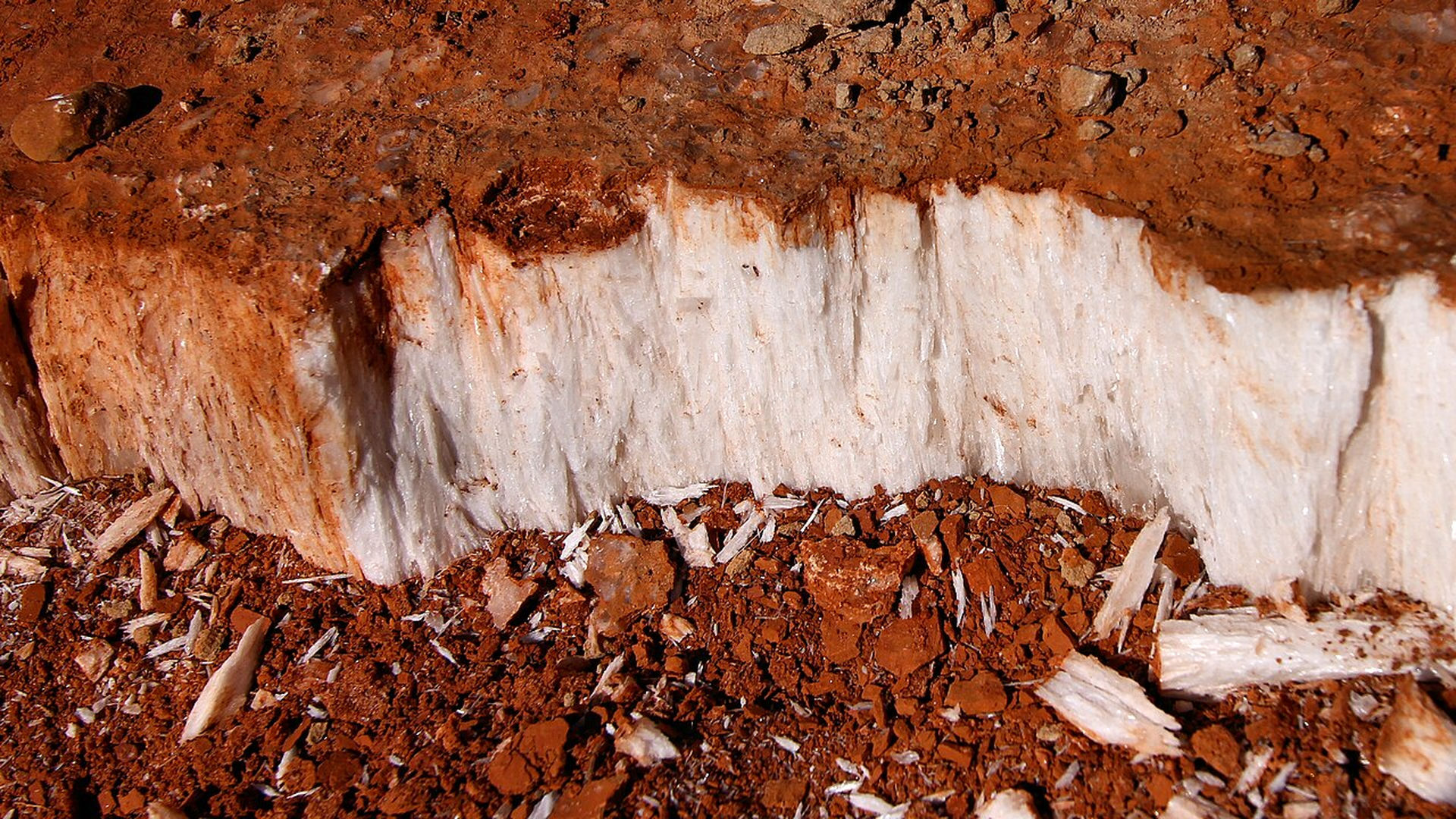
Across Australia, many First Nations groups produced plaster from gypsum. The chemical reaction involved is called calcination, where the substances were fired to dehydrate them, removing carbon dioxide and sulfur dioxide. This left behind a plaster, kopi, that the Diyari Peoples from near Lake Eyre in South Australia used for mourning caps as part of mourning rituals and to make balls called koolchee for a ball-throwing and hitting game.
Gypsum in sedimentary rock, image by Larry D. Moore via Wikimedia Commons, licensed under CC BY 4.0
Hamm G, Rowlands D and Smith M (2019) ‘Frontier mystery: An unusual mound of kopi mourning caps on the eastern edge of the Simpson Desert’, Queensland Archaeological Research, 22:59–63, doi: 10.25120/qar.22.2019.3700
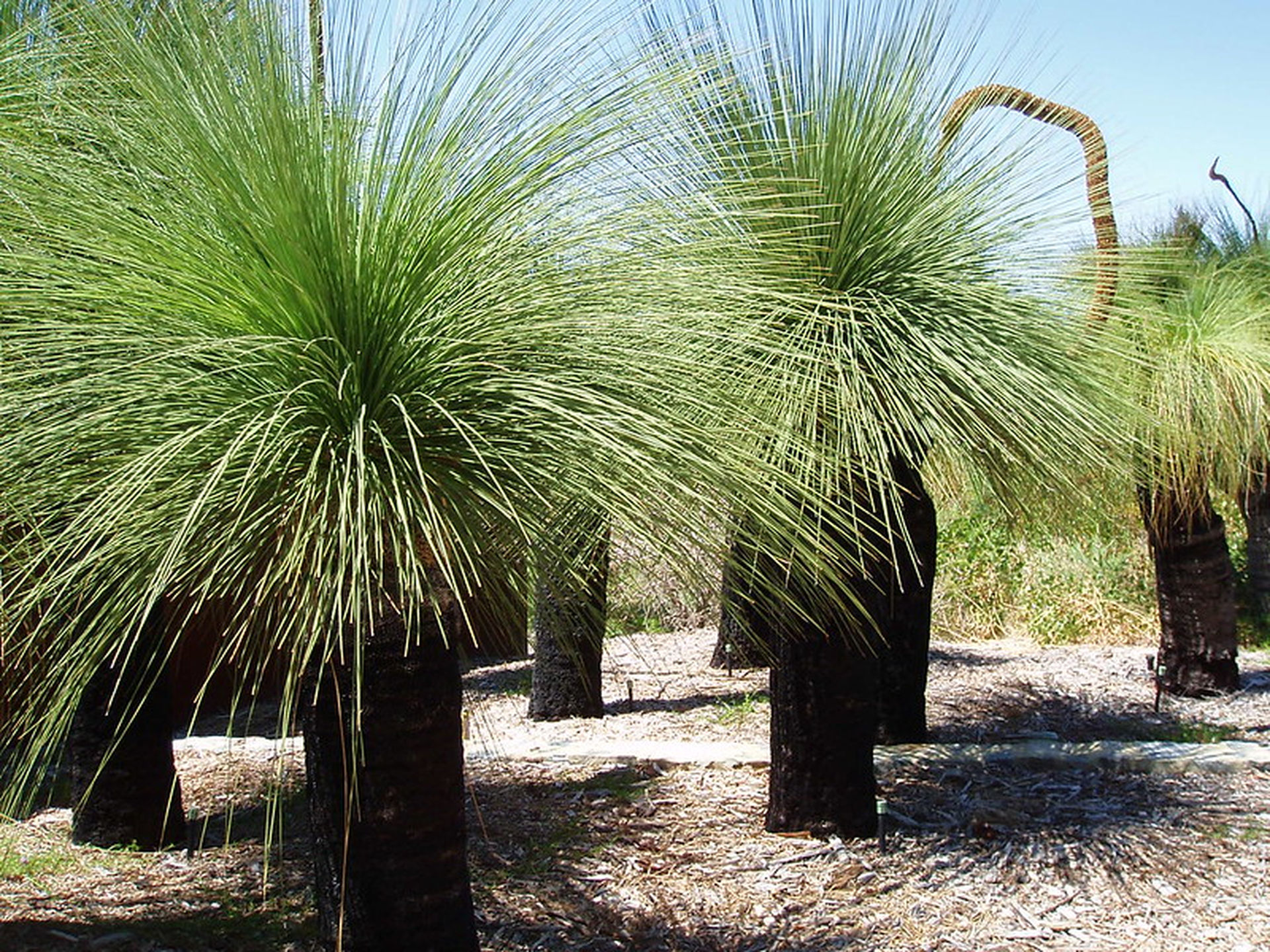
Knowing the ways chemicals reacted also helped people prevent useful substances from becoming unusable. For example, the Wadjari Peoples in central Western Australia found that heating grasstree resin too quickly caused it to froth and crumble. A study by Parr in 1999 suggested that this was because of the loss of volatile (easily evaporated) substances from the resin and possibly oxidation reactions, which irreversibly changed the resin. Go to this page to read more about oxidation.
Grasstree resin comes from Xanthorrhoea trees. Image by via Flickr, licensed under CC BY-SA 2.0
Parr J (1999) ‘Once, twice maybe, but not three times: Reheating Xanthorrhoea australis resin’, Australian Archaeology, 49(1):23–27, doi: 10.1080/03122417.1999.11681650
Dr Katrina Wruck is a proud Mabuygilayg, research fellow in materials science for industrial chemistry, lecturer at the School of Medical, Mechanical and Process Engineering, founder of Nguki Kula Green Labs, and 2025 Young Australian of the Year. Her accolades reflect her commitment to connecting Traditional Knowledges and Eurocentric science to make industrial processes greener.
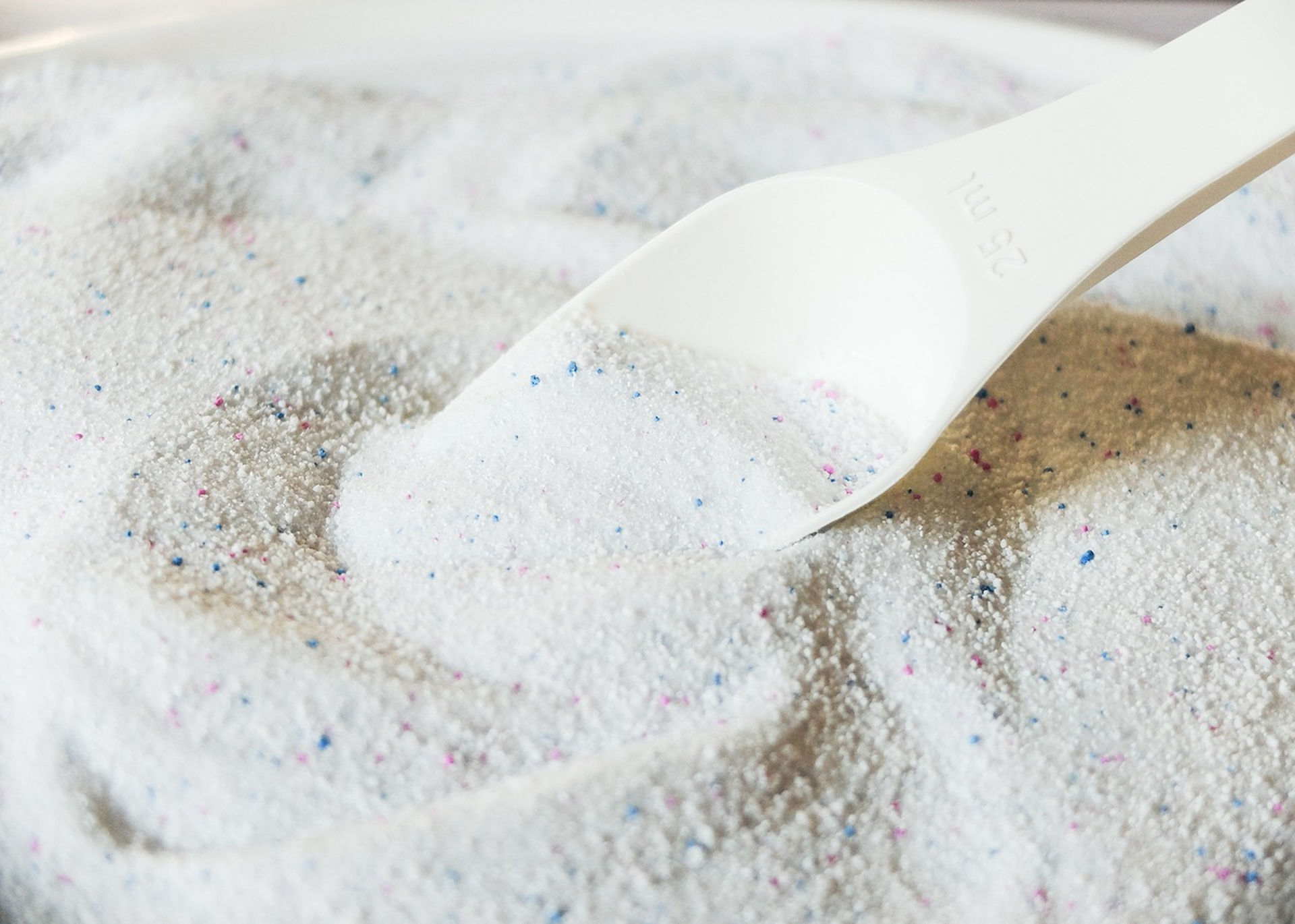
Katrina has developed a method for converting by-products from mining into a useful substance called zeolite LTA. Zeolites can absorb and filter harmful substances, and are used in everyday processes – from washing our laundry to soaking up odours in cat litter and treating wastewater. Beyond their current uses, zeolites have enormous potential across a wide range of fields, including agriculture, aquaculture, construction, medicine and biotechnology.
Katrina has also optimised this process, greatly reducing the temperatures required to produce zeolites. Katrina's work embodies the ACS Principles of Green Chemistry: waste mining by-products become a valuable resource, and the process itself demands less energy, turning two environmental problems into one elegant solution.
Her ongoing research focuses on chemical processes to break down 'forever chemicals'– synthetic compounds that persist in the environmenta and cause long-term harm.
Zeolites are found in many laundry detergents around the world. They help soften the water by removing hard ions like Ca2+ and Mg2+. Image by Frank Habel via Pixabay
Wruck K, Millar GJ and Wang T (2021) 'Transformation of heulandite type natural zeolites into synthetic zeolite LTA', Environmental Technology & Innovation, 21:101371, doi: 10.1026/j.eti.2021.101371