Unlike the fairy lights from the previous page, the appliances in your home are wired in parallel. This is why your refrigerator keeps running when your toaster fails. Each component sits on its own independent path, so a break in one branch doesn't affect the others. This resource builds on series circuits to explore how current, voltage and resistance behave when components are connected in parallel.
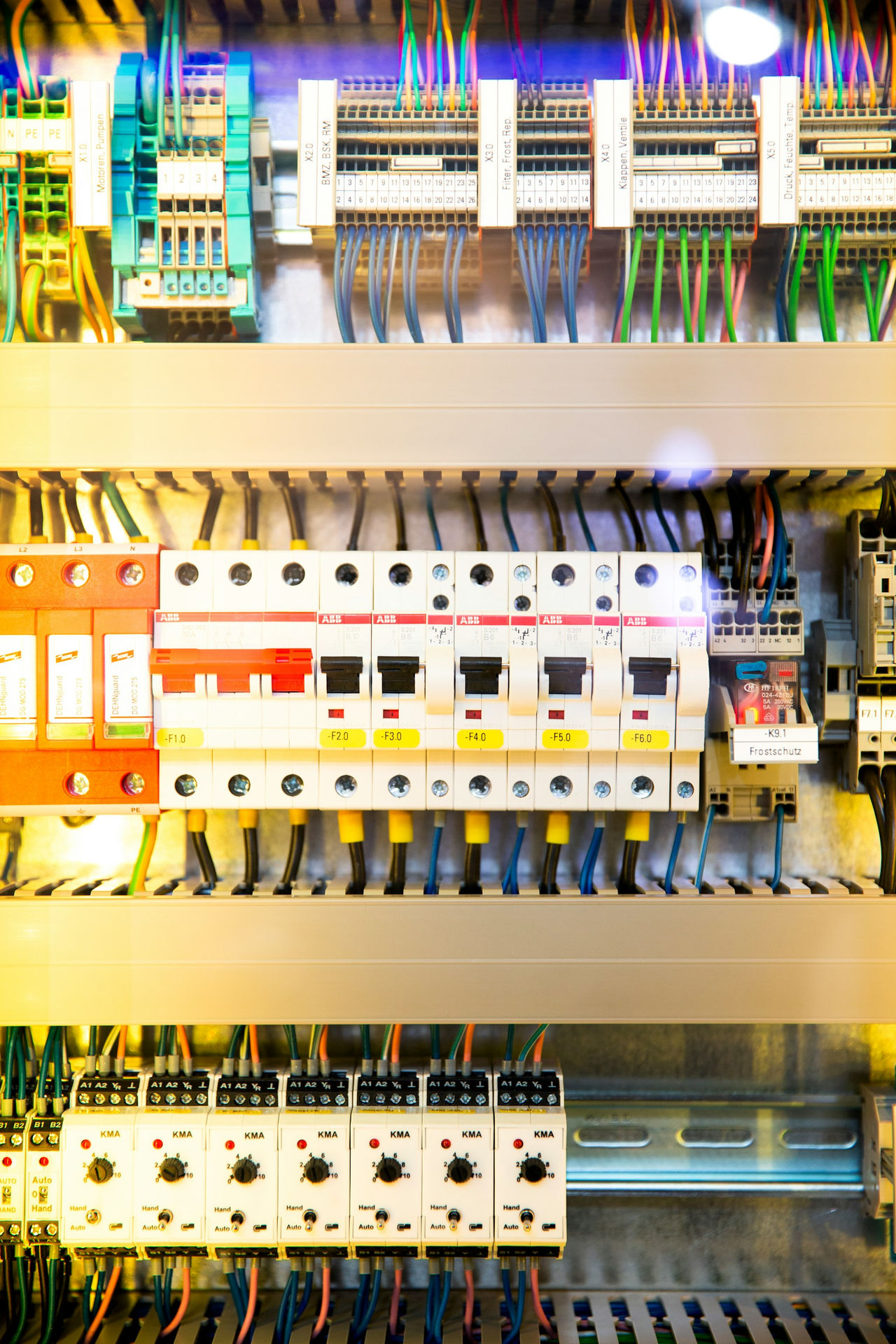
In parallel, components are connected side by side, each with its own path from the supply. Unlike a series circuit, the current splits across the branches – each component draws its own current independently, so the total current from the supply is the sum of all the branch currents. One important example is an electrical switch box. In a household, individual circuit breakers in the box control a separate parallel branch, such as lighting or your kitchen.
This means that adding more parallel branches gives the current more paths to flow through, which lowers the overall resistance. The effective resistance of resistors in parallel is therefore always less than the smallest individual resistor.
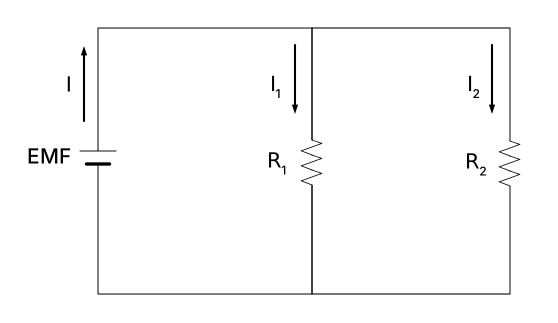
Consider two resistors \(R_{1}\) and \(R_{2}\) connected in parallel across a battery.
This means that \(R_{EQ}\) is the reciprocal, \(\dfrac{20}{3}\approx6.7\,\Omega\). See how \(R_{EQ}\) is smaller than the two resistances \(R_{1}\) and \(R_{2}\)?
What total current will flow through them and what power will be produced if the combination is placed across a \(\mathbf{12}\,\textbf{V}\) battery?
To then calculate the power, we need to use \(P=V\times I\).
\[\begin{align*} P & = V\times I \\[6pt]
& = 12\times1.791\\[6pt]
& = 21.49\,\text{W}\end{align*}\]
Exercise – measuring electricity in parallel circuits
Two torch bulbs are placed in parallel with each other across a \(3.0\,\text{V}\) battery. The current through the battery is \(0.55\,\text{A}\). The current through one of the bulbs is \(0.25\,\text{A}\).
What is the current through the other bulb?
What is the voltage across the other bulb?
\(0.3\,\text{A}\)
\(3\,\text{V}\)
What is the effective resistance of two \(10\,\Omega\) resistors:
in series?
in parallel?
\(20\,\Omega\)
\(5\,\Omega\)
Two equal resistors are placed in parallel and found to have a combined resistance of \(34\,\Omega\). What is the resistance of each one?
\(68\,\Omega\) each
A \(10\,\text{V}\) power supply is used across two separate resistors. The current through one is found to be \(0.4\,\text{A}\), and through the other \(0.5\,\text{A}\). When they are combined in parallel:
what current will flow through them?
what is their effective resistance?
\(0.9\,\text{A}\)
\(11.1\,\Omega\)
A current of \(3\,\text{A}\) is found to be flowing through two resistors of \(20\,\Omega\) and \(10\,\Omega\) in parallel.
What is the effective resistance of the combination?
What is the voltage across the pair of resistors?
How much current will be flowing in each resistor?
How much power will be dissipated (used up) in each of the two resistors?
\(6.7\,\Omega\)
\(20\,\text{V}\)
\(1\,\text{A}\) in \(20\,\Omega\) and \(2\,\text{A}\) in \(10\,\Omega\)
\(20\,\text{W}\) in \(20\,\Omega\) and \(40\,\text{W}\) in \(10\,\Omega\)
Three resistors of \(900\,\Omega\), \(1.5\,\text{k}\Omega\) and \(2.0\,\text{k}\Omega\) are to be used in a circuit. What is their effective resistance if they are all placed: